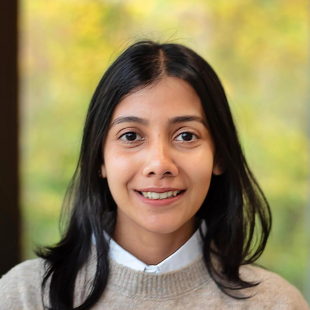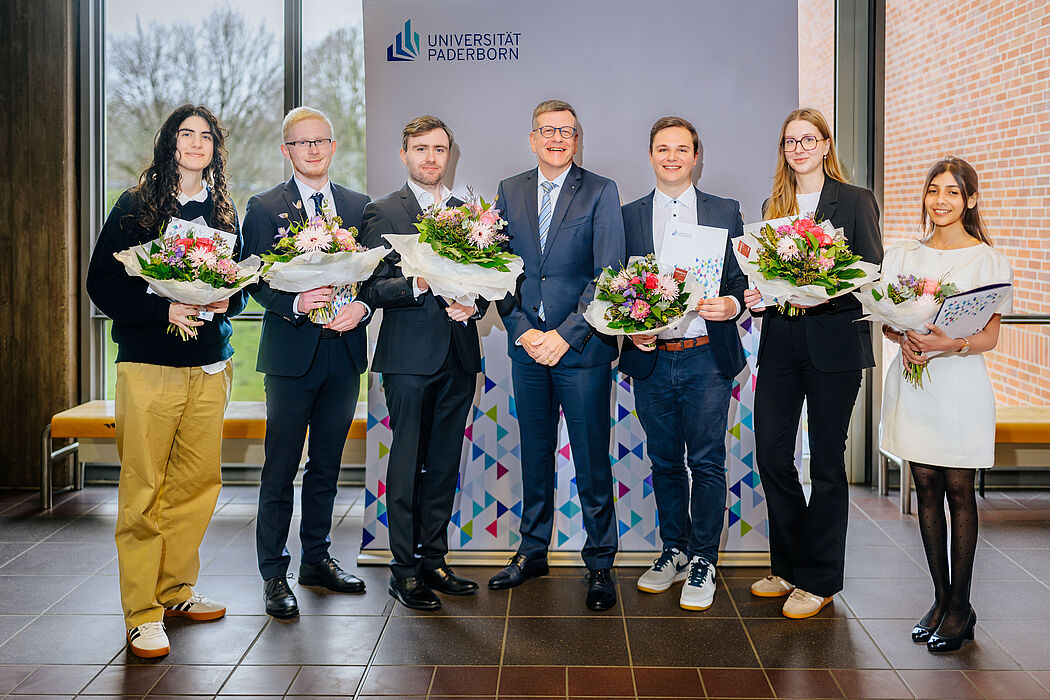
Rose Sunil, a graduate of the Computer Science master's programme at Paderborn University, has been awarded the Paderborn University Society's prize for outstanding theses for her outstanding master's thesis in the field of software engineering and artificial intelligence. Her research is dedicated to the question of how large language models (LLMs) can be used to analyse complex software structures.
Rose Sunil studied Computer Science at Paderborn University from 2022 to 2025 and graduated with a grade of 1.4. At the same time, she gained practical experience as a working student in software development at Phoenix Contact and as a student assistant at the Heinz Nixdorf Institute. Prior to this, she worked for several years as a Senior Systems Engineer at Infosys in India. For her outstanding academic achievements and commitment, she also received a scholarship from the OWL Study Fund Foundation as part of the Deutschlandstipendium programme.
In this interview, Rose Sunil talks about her research into AI-supported programme analysis, her experiences studying at Paderborn University and what role artificial intelligence could play in software development in the future.
Ms Sunil, congratulations on your award! What does this award mean to you personally?
For me, this award is both an honour and a great acknowledgement of the work I put into my master's thesis. It reflects not only the professional contribution, but also the supervision and the supportive environment that surrounded me.
Personally, it gives me the confidence to continue my research and deepen my work in the areas of software engineering and programme analysis.
What is your master's thesis about and why is call graph analysis so important for software development?
My master's thesis investigates how large language models can be used to create call graphs in static analysis and evaluates their performance across multiple programming languages.
Call graphs describe which functions within a programme can call which other functions. They form the basis for many advanced tasks in the field of software development. Inaccurate call graphs lead to inaccurate analyses, so improving their creation has a direct impact on software quality and security.
What motivated you to use large language models for a classic programme analysis task?
Large language models have shown impressive capabilities in understanding source code. We were curious whether these capabilities could complement or even enhance classical static analysis techniques. Rather than viewing AI as a replacement, we wanted to systematically investigate whether it can make a meaningful contribution to an established analysis problem and under what conditions this is possible.
You analysed 26 different language models in several programming languages. What was the most important insight you gained from this comparison?
One important finding was that performance depends heavily on both the model architecture and the programming language. Larger models did not always guarantee better results, and generalisation across different languages was not trivial.
Where do you currently see the greatest strengths, but also the limitations of AI models in software analysis?
AI models are particularly strong in dealing with incomplete or ambiguous information and in recognising common coding patterns learned from large corpora. However, they lack formal guarantees and can produce inconsistent results. For safety-critical or safety-relevant analysis tasks, explainability and correctness remain major challenges.
With SWARM-CG and SWARM-JS, you have developed your own benchmark frameworks. How important are open source tools for your research?
Open source tools are essential for reproducibility and transparency. By publishing benchmark frameworks, we enable other researchers to validate results, compare approaches fairly and build on existing work. In rapidly evolving research areas such as AI for software development, a common infrastructure is crucial.
Your research results have been published and have attracted international attention. What does this response mean for you as a young scientist?
The feedback was very encouraging. It shows that the research question resonates with a broad audience and motivates me to continue working on topics with a broad scope. It also emphasises the value of collaboration and exchange between different institutions.
What role did Paderborn University play in the development of your work, particularly in terms of research, supervision and international visibility?
Paderborn University provided an excellent research environment with strong expertise in secure software development and programme analysis. The supervision, structured discussions and opportunities for publication have significantly influenced the quality and scope of my work.
What would you like to continue researching in the future and what are your next steps after completing your Master's degree?
After completing my Master's degree, I am now continuing my research as a doctoral candidate at the Heinz Nixdorf Institute. I am currently part of the ERC-funded research project "Self-Optimising Static Program Analysis" (SOSA), which investigates how static analysis techniques can automatically adapt and improve their efficiency and precision.
The overall goal is to contribute to the development of more intelligent, scalable and practical software analysis systems that can better support developers in ensuring the quality and security of software.
How has Paderborn University supported you on your academic path and why do you think it offers particularly good conditions for research at the interface of software engineering and artificial intelligence?
Paderborn University has had a significant influence on my academic career. My experiences during my Master's programme strongly influenced my decision to do my doctorate here. The university offers access to strong research groups, close supervision and international research networks that have significantly supported my development as a young researcher.